
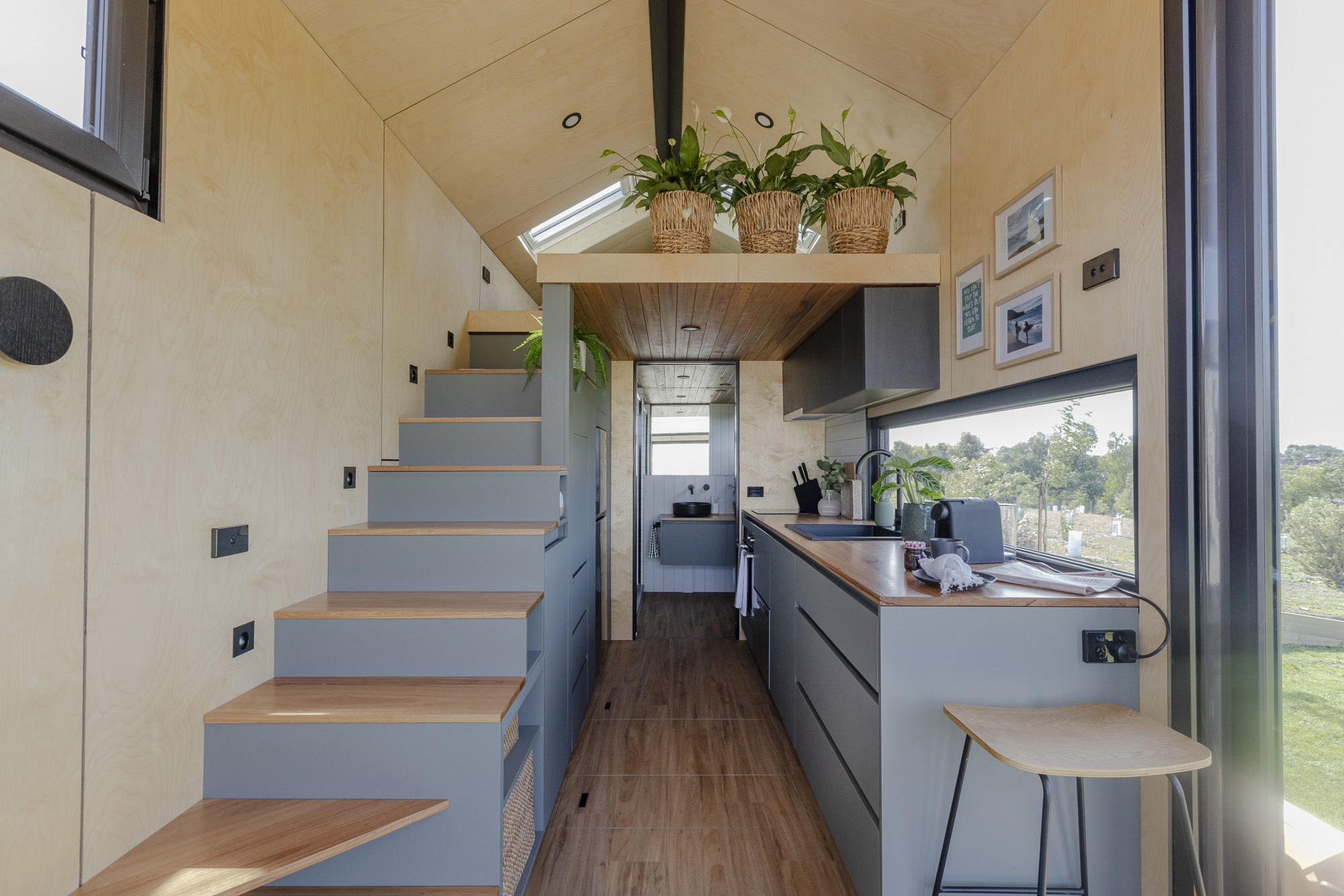
Owning a tiny home on wheels offers a different path. It can provide a comfortable, well-designed place to live without taking on the financial commitment of a conventional house — while also creating flexibility for the future.
That future might include relocating the tiny home on wheels, placing it on family land, using it as guest accommodation or, where local requirements allow, turning it into short-stay accommodation that generates revenue.
For us, that flexibility is one of the most compelling reasons to consider owning a tiny home on wheels.
A Different Path to Owning Your Own Home
Our family has experienced this firsthand.
We originally designed a tiny home on wheels to give our eldest son greater independence while he saves and invests toward purchasing property of his own.
Rather than committing a significant portion of his income to rent, he has his own space while working toward a longer-term financial goal.
It gives him privacy and independence while remaining close to family — and importantly, the tiny home on wheels itself has value and a potential life well beyond its original purpose.
When his circumstances eventually change, the building doesn’t necessarily become redundant.
It could be relocated, used for family or guest accommodation, or potentially repositioned as short-stay accommodation.
That ability to evolve with changing circumstances is where owning a tiny home on wheels becomes particularly interesting.
From Your Own Home to Short-Stay Accommodation
A conventional home is generally tied permanently to its location and purpose.
A tiny home on wheels offers a different kind of flexibility.
Someone might initially purchase one as their own place to live while saving toward another property. Several years later, their circumstances may change.
Rather than simply selling the tiny home on wheels, there may be an opportunity to move it onto suitable land and give it a completely different purpose.
For example, it could become:
- short-stay accommodation on a rural or coastal property
- additional accommodation at a farm stay or winery
- a private guest space for visiting family and friends
- accommodation associated with an existing tourism business
- an additional accommodation offering on underused land.
Of course, what is possible depends on the property, intended use and relevant council and regulatory requirements. These should always be investigated before making an investment decision.
But the important point is optionality.
You’re not necessarily buying a space that can only serve one purpose.
Why Short-Stay Accommodation Changes the Equation
When considering the cost of a tiny home on wheels, it can be useful to think beyond the initial purchase price.
Ask instead:
What could this asset potentially do for me over the next 5, 10 or 15 years?
If the tiny home eventually becomes short-stay accommodation, it has the potential to move from being primarily a living expense to an income-producing accommodation asset.
A thoughtfully positioned tiny home on wheels can be particularly well suited to nature-based accommodation.
Guests aren’t necessarily searching for the biggest space. They’re often searching for an experience — somewhere peaceful, private and comfortable that gives them a reason to escape their normal routine.
A beautiful outlook, large windows, a comfortable bed, a well-designed bathroom, an inviting outdoor area and a strong connection to the surrounding landscape can matter enormously.
We See This From the Hosting Side Too
At Manuka Tiny Homes, our understanding of this opportunity isn’t based purely on building them.
We also host a tiny home on wheels for short stays ourselves.
That experience gives us another perspective on what makes a compact space work.
Our guests love the opportunity to slow down, enjoy the surrounding environment and stay somewhere that feels different from conventional accommodation.
It has also shown us that good guest accommodation isn’t simply about fitting a kitchen, bathroom and bed into a small footprint.
The layout, natural light, privacy, storage, outlook, heating and cooling, bathroom comfort and overall atmosphere all contribute to the guest experience.
Those lessons influence the way we think about the tiny homes on wheels we build.
Design for How the Tiny Home Could Be Used Tomorrow
If there’s even a possibility that your tiny home on wheels could eventually become guest accommodation, it’s worth considering that during the design stage.
A layout that works well for one person living permanently in the space may not necessarily be the best layout for paying guests.
Think about features such as comfortable sleeping arrangements, a quality bathroom, intuitive storage, good heating and cooling, natural light and a strong indoor-outdoor connection.
The location of windows can be particularly important.
On the right property, framing a rural, bush or coastal outlook can turn a relatively compact accommodation space into something memorable.
That can ultimately influence how guests perceive the stay — and potentially how attractive the accommodation is in a competitive short-stay market.
A Tiny Home on Wheels Can Have More Than One Life
This is perhaps the biggest advantage.
Your needs today may be completely different from your needs ten years from now.
A tiny home on wheels might begin as your first independent home.
Later, it could become accommodation for an adult child.
Then guest accommodation.
And eventually, subject to the property and relevant approvals, it could become part of a short-stay accommodation business.
That adaptability means you’re thinking beyond simply buying somewhere to sleep.
You’re considering an asset that can potentially change purpose as your life, property or business changes.
Could a Tiny Home on Wheels Work for You?
For some buyers, the priority will be having a comfortable place of their own without purchasing a conventional house.
For others, the attraction will be adding accommodation to land they already own.
And increasingly, property owners may see an opportunity to combine the two — owning a high-quality tiny home on wheels now while retaining the possibility of generating accommodation revenue from it later.
The right approach depends on your land, budget, intended use and local requirements.
But designing with future flexibility in mind can give you considerably more options.
Build for Today. Plan for Tomorrow.
At Manuka Tiny Homes, we build high-quality tiny homes on wheels in Victoria designed around real-world use — from independent living and family accommodation through to guest and short-stay accommodation.
If you’re considering owning a tiny home on wheels and want to understand how the design could support both your immediate needs and future accommodation opportunities, we’d be happy to talk through the possibilities.
Thinking about a tiny home on wheels for yourself, your land or future short-stay accommodation? Get in touch with Manuka Tiny Homes to explore what could work for you.