
Tiny Home on Wheels Biggest Myths Debunked: Time for a Change

by | Mar 5, 2025

Tiny Home on Wheels Biggest Myths Debunked: Time for a Change

by | Mar 5, 2025

A practical guide for landowners, homeowners and accommodation providers considering a tiny home on wheels for guest accommodation, extra space or short-stay income potential.

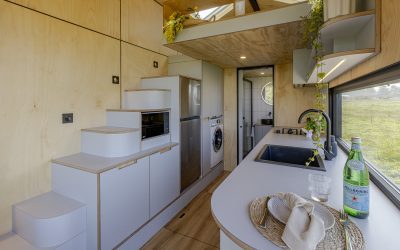
Cozy and functional tiny home on wheels interior featuring dual-purpose furniture, soft furnishings, and smart storage solutions, designed for comfort and space efficiency.

Tiny Home on Wheels Living – A Personal Perspective 

As a family of five (plus pup!), we’ve often discussed housing solutions that balance affordability, comfort, and sustainability. One of our biggest concerns was whether a Tiny home on wheels could provide enough space to live comfortably.

But after designing and living with smart storage solutions, we realized something: space is about design, not size.

Many people hesitate to embrace tiny living because of myths about limited space, discomfort, and lack of storage. Today, we’re setting the record straight.

Myth 1: “You’ll Feel Cramped”

Reality: Smart Design Expands Your Space

Tiny homes on wheels are designed with multi-functional furniture, high ceilings, and open layouts to create a spacious feel.

Dual-Purpose Furniture – Couches convert into beds, dining tables fold into walls, and stairs double as storage.
Loft Bedrooms – Sleeping areas are elevated to free up ground-floor space.
Large Windows & Natural Light – Bright interiors make rooms feel more open and airy.

Myth 2: “There’s No Storage”

Reality: Creative Storage Solutions Maximize Every Inch

Tiny homes use smart storage hacks that keep clutter out of sight while maintaining functionality.

Built-In Storage Under Stairs & Beds – Every step can be a drawer.
Wall-Mounted Shelves & Pegboards – Vertical storage keeps essentials accessible.
Multi-Use Cabinets & Hidden Compartments – Custom cabinetry is designed to fit specific needs.

Myth 3: “It’s Too Closed Off”

Reality: Indoor-Outdoor Flow Expands Your Living Area

By incorporating seamless transitions between indoor and outdoor spaces, tiny homes feel much larger than their footprint suggests.

Sliding Glass Doors – Extend living spaces onto decks and patios.
Outdoor Decking & Pergolas – Create additional relaxation areas.
Large Windows & Skylights – Bring in natural light and connect the home to nature.

How Manuka Tiny Homes Maximizes Space Without Sacrificing Comfort

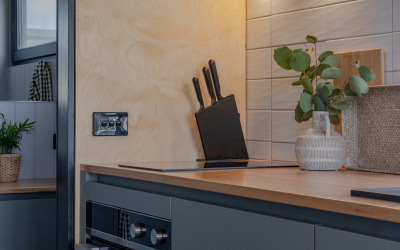
At Manuka Tiny Homes, we design homes that don’t just look great—they work for real-life living.

Customizable Designs – Choose layouts that fit your lifestyle.
Sustainable Materials – Eco-friendly choices for long-term living.
Expert Craftsmanship – Built for comfort, durability, and efficiency.

Tiny homes on wheels are not just about downsizing—they’re about upgrading to a simpler, more functional, and sustainable way of living.

Ready to See How Spacious a Tiny Home Can Be?

Explore our designs and find out how dual-purpose furniture and smart layouts make tiny home living more spacious than you ever imagined.


Share this guide:

Frequently Asked Questions

Common Questions & Australian Regulations

Can I build a tiny house on a second-hand caravan or boat trailer?

We strongly advise against it. Second-hand caravan and boat trailers are rarely engineered to support the continuous 3.5T–4.5T concentrated dead load of timber framing, double-glazed windows, appliances, and water storage. Modifying an old trailer frequently violates ADR compliance and will make obtaining an Australian registration compliance certificate virtually impossible.

What is the maximum legal width and height for towing in Australia without pilot vehicles?

Under Australian National Heavy Vehicle regulations, the standard legal dimensions for general access without special oversize permits or escort vehicles are a maximum width of 2.50 meters, a maximum height of 4.30 meters from road surface to the highest point, and a maximum total vehicle and trailer combined length of 19.0 meters.

How do you prevent rust when a tiny home is positioned near coastal areas?

All Manuka Tiny Homes chassis utilize structural hollow sections (SHS) and C-channels that undergo full chemical pickling followed by hot-dip galvanizing to AS/NZS 4680 standards. For severe marine environments (within 1km of surf coastline), we also offer an additional 2-pack epoxy zinc underbelly barrier.

Do I need special towing licenses to relocate a 4.5-tonne tiny home?

In most Australian states, a standard Class C car driver license permits towing up to the rated towing capacity of your vehicle. However, towing a 4.0T–4.5T trailer requires a heavy-duty tow vehicle (such as an American pickup truck like a Ford F-250, RAM 2500, or light commercial truck) fitted with an approved 70mm ball or pintle hitch and an electric brake controller. Many owners choose a professional insured heavy-towing transport contractor for peace of mind.

Recommended Reading

Related Guides & Technical Articles

Could a Tiny Home on Wheels Work on Your Property?

If you have usable land and are thinking about guest accommodation, family stays or short-stay income, the first step isn't choosing a design — it's understanding whether your property is suitable.

Our free Property Readiness Check looks at access, site position, services, privacy and intended use, and gives you a practical answer in about 3 minutes.

Free · Takes about 3 minutes · No obligation.